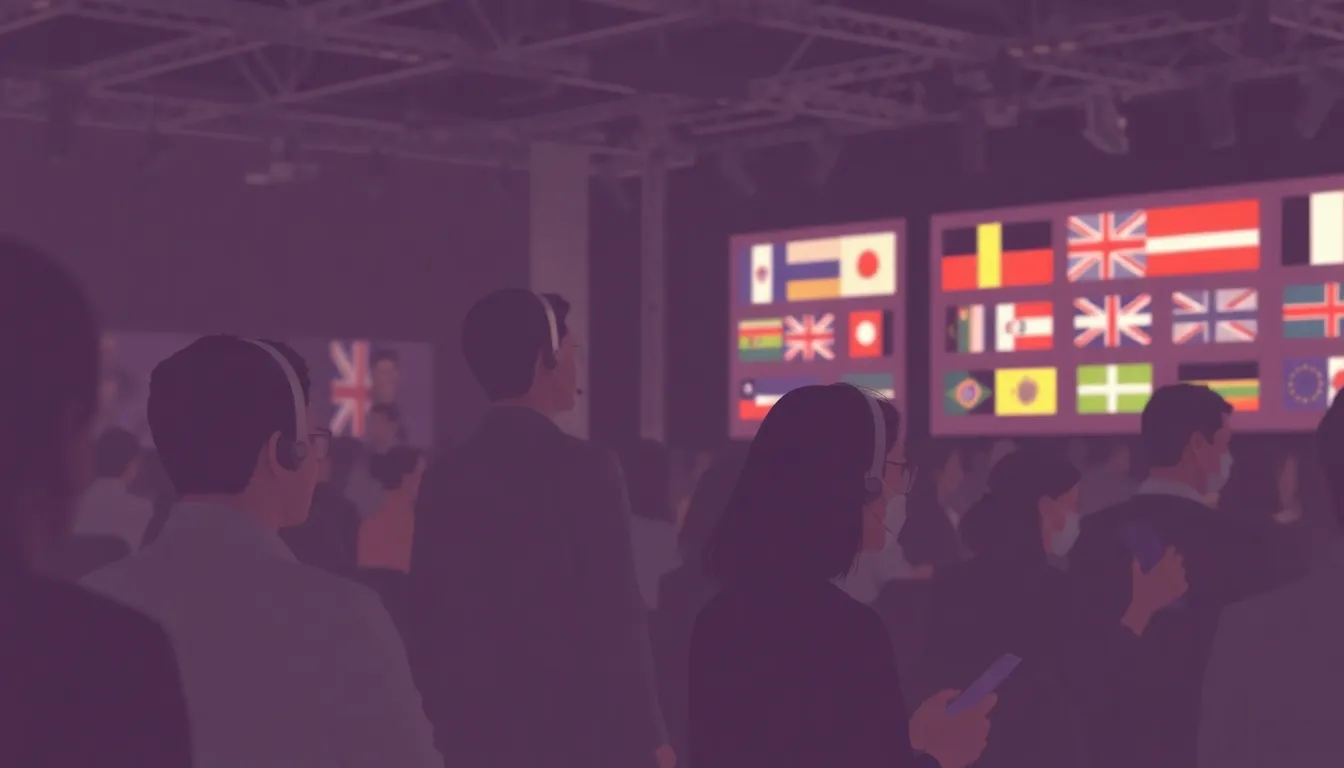
The modern event landscape has shifted dramatically. Walk into any major conference, trade show, or corporate summit today, and you'll encounter attendees from dozens of countries, speaking languages that span continents. According to 2026 benchmarks from Wordly's State of AI Translation & Captions report, 79% of enterprise event stakeholders report that the number of non-native English speakers attending their events is actively increasing, with 28% saying that half or more of their total audience is now non-native English speakers.
For event organizers, this isn't just a demographic shift—it's a fundamental challenge to how we design, deliver, and measure event success. Language barriers can silently erode engagement, limit networking opportunities, diminish sponsor visibility, and ultimately reduce the return on investment for both organizers and attendees. The question is no longer whether to accommodate multilingual audiences, but how to do it effectively, efficiently, and at scale.
In this comprehensive guide, we'll explore the strategic imperatives, technology solutions, and practical tactics that leading event organizers are using to create truly inclusive multilingual experiences—and how to integrate language accessibility seamlessly with modern engagement tools like gamification, digital check-ins, and interactive agendas.
The Business Case for Multilingual Event Design
Before diving into execution, it's worth understanding why multilingual capabilities have become mission-critical for event success in 2026. The data tells a compelling story.
A 2026 ROI benchmarks study from Wordly found that 88% of organizations increased their use of live interpretation and captioning over the past year, with 41% now providing live interpretation and 42% providing live captioning at every single event they host. This isn't experimentation—it's strategic infrastructure.
Even more striking: 99% of respondents in the same 2026 study say that adding live interpretation and captions increases event ROI and general business effectiveness, attributing this to higher audience engagement, better attendance rates, and improved learning comprehension. When language barriers are removed, attendees participate more actively, retain more information, and report higher satisfaction scores.
Regional demand varies but trends upward globally. According to a 2025 study by Interprefy, 86% of event organizers in the Middle East and 71% in APAC report high demand for multilingual delivery, driven by diverse audiences and significant cross-border participation. Even in traditionally English-dominant markets like North America and Europe, organizers are recognizing that inclusive language policies expand reach, strengthen brand reputation, and open doors to international sponsorship opportunities.
The bottom line: multilingual capability isn't an accessibility add-on anymore—it's a competitive differentiator that directly impacts attendance, engagement metrics, and revenue.
Understanding Your Audience's Language Needs
Effective multilingual event planning begins long before attendees arrive. The first step is understanding who will be in the room and what they need to fully participate.
Conduct Pre-Event Language Surveys
During registration, ask attendees to indicate their preferred language and whether they'll need interpretation or captioning services. This simple data collection allows you to:
- Determine which languages to prioritize for interpretation
- Estimate the demand for different service levels (simultaneous interpretation, live captions, translated materials)
- Identify sessions with the highest multilingual attendance to allocate resources strategically
- Plan seating or breakout room configurations that accommodate language-specific groups
Many registration platforms now include language preference fields as standard. If yours doesn't, add a simple dropdown or checkbox question—it's one of the highest-ROI data points you can collect.
Map Language Diversity to Session Types
Not every session requires the same level of language support. Keynotes with broad appeal and technical deep-dives with specialized terminology have different needs. Create a matrix that considers:
- Session format: Presentations, panels, workshops, and networking events each present unique translation challenges
- Content complexity: Highly technical or jargon-heavy sessions may require specialized interpreters or glossaries
- Expected audience mix: Use registration data to predict which sessions will draw the most non-native speakers
- Interaction level: Q&A segments, roundtables, and breakouts need real-time bidirectional interpretation
This mapping helps you allocate budget and technology resources where they'll have the greatest impact, rather than trying to provide identical support across every session.
Technology Solutions: From Human Interpreters to AI-Powered Translation
The toolkit for multilingual events has expanded dramatically. In 2026, organizers have access to a spectrum of solutions, each with distinct strengths, cost profiles, and use cases.
Simultaneous Human Interpretation
Traditional simultaneous interpretation—where professional interpreters work in soundproof booths, translating speeches in real-time while attendees listen via headsets—remains the gold standard for high-stakes events, diplomatic gatherings, and sessions with complex, nuanced content.
Advantages include exceptional accuracy, cultural sensitivity, and the ability to handle unexpected content shifts. The trade-offs: significant cost (typically hundreds to thousands of dollars per language pair per day), logistical complexity (booths, equipment, coordination), and geographic constraints (interpreters must be on-site or connected via specialized remote platforms).
AI-Powered Real-Time Translation and Captioning
The technology landscape has matured rapidly. According to the 2026 Wordly enterprise benchmark report, 88% of organizers already use AI interpretation and 91% use AI captioning, with 66% stating that AI quality is now better than human interpretation for their specific use cases.
Modern AI translation platforms offer:
- Live speech-to-speech translation through attendee mobile apps or web interfaces
- Real-time captioning displayed on screens or personal devices
- Support for dozens of languages simultaneously without per-language cost scaling
- Cloud-based deployment that integrates with virtual, hybrid, and in-person formats
The economics are compelling: AI solutions typically cost a fraction of human interpretation and scale effortlessly. Quality has reached a threshold where most general business content, presentations, and panel discussions are translated with high accuracy, though highly specialized terminology or heavily accented speech can still pose challenges.
Hybrid Approaches
Many sophisticated organizers now blend methods strategically: human interpretation for keynotes and CEO remarks where precision is paramount, AI-powered translation for breakout sessions and networking spaces where scale and flexibility matter most, and multilingual captioning as a universal baseline that supports both accessibility and language diversity.
This tiered approach optimizes cost, quality, and coverage while ensuring that every attendee has at least one pathway to access content in their preferred language.
Integrating Multilingual Support with Event Technology
Language accessibility doesn't exist in isolation. The most successful multilingual events weave translation and interpretation seamlessly into the broader attendee experience—including gamification, digital agendas, networking tools, and sponsor engagement.
Multilingual Agendas and Session Discovery
Your event agenda is often the first touchpoint for attendees planning their day. If session titles, descriptions, and speaker bios are only available in English, non-native speakers face an immediate barrier to participation.
Modern agenda builders with multilingual support allow you to:
- Publish session details in multiple languages simultaneously
- Let attendees toggle their preferred display language
- Tag sessions with available interpretation languages so attendees can filter by accessibility
- Embed language preferences into personalized schedule recommendations
When you explore all features of a comprehensive event engagement platform, look for agenda tools that handle multilingual content natively, rather than requiring duplicate entries or third-party translation plugins.
Gamification for Multilingual Audiences
Gamification—using points, challenges, leaderboards, and rewards to drive engagement—is one of the most effective ways to encourage participation and create memorable experiences. But if game mechanics, challenge descriptions, or leaderboard interfaces are language-locked, you risk excluding significant portions of your audience.
Consider how gamification elements translate across languages:
- QR code stamp passports: Visual by nature, these work across languages when paired with simple icons and multilingual prompts. An attendee can scan a code at a sponsor booth or session entrance regardless of their native language.
- Challenge descriptions: "Visit three sponsor booths" or "Attend a morning keynote" should be displayed in the attendee's selected language within your event app or web interface.
- Leaderboards: Names and point totals are universal, but category labels, achievement badges, and reward descriptions need localization.
- Push notifications: Real-time alerts about leaderboard position, new challenges, or prize opportunities must be delivered in the recipient's preferred language to drive action.
The good news: when gamification is built on a flexible platform with multilingual support, these adaptations are straightforward. Attendees engage more when they can fully understand the rules, see their progress, and compete on equal footing—regardless of language.
Networking Tools That Cross Language Barriers
Networking is often cited as the top reason people attend events in person, yet language differences can make spontaneous connection uncomfortable or intimidating. Digital networking tools can help bridge this gap.
Look for platforms that support:
- Profile discovery with language tags: Let attendees identify the languages they speak so others can find potential conversation partners with shared linguistic ground.
- Interest-based matching: When attendees are matched by professional interests, industry, or goals, language becomes one factor among many—reducing its weight as a barrier.
- In-app messaging with translation assistance: Some advanced platforms offer built-in message translation, allowing attendees to communicate across language boundaries asynchronously.
- Multilingual icebreaker prompts: Provide conversation starters, discussion topics, or networking challenges in multiple languages to ease first interactions.
When networking tools are designed with linguistic diversity in mind, you create more equitable opportunities for connection—and attendees report higher satisfaction and stronger professional outcomes.
Practical Tips for Delivering Multilingual Sessions
Technology enables multilingual events, but thoughtful planning and execution make them successful. Here are field-tested strategies from organizers running sessions for diverse, global audiences.
Prepare Speakers and Moderators
Brief your speakers well in advance about the multilingual nature of the audience. Key guidance includes:
- Speak clearly and at a moderate pace: Both human interpreters and AI systems perform better when speech is measured and articulate.
- Avoid idioms, slang, and culturally specific references: Phrases like "hit it out of the park" or "that's a home run" may confuse non-native speakers and complicate translation.
- Use visual aids generously: Slides with clear diagrams, charts, and bullet points help reinforce spoken content and transcend language.
- Pause for interpretation: If using consecutive interpretation (less common but still valuable in small settings), build in natural pauses for interpreters to catch up.
- Provide glossaries for technical terms: Share key terminology, acronyms, and product names with interpreters or AI platforms in advance to improve accuracy.
Create Multilingual Signage and Wayfinding
Physical and digital navigation cues should reflect your audience's diversity. Print signage in the top 2-3 languages represented at your event, use universally recognized icons wherever possible, and ensure that your event app's map and wayfinding features support language switching.
This applies to sponsor booths as well—encourage exhibitors to provide multilingual collateral, staff booths with language-diverse representatives, or use digital displays that cycle through multiple languages.
Test Technology Before Go-Live
Run full tech rehearsals with your interpretation and captioning systems at least 48 hours before the event. Test with actual speakers, confirm audio quality, verify that attendee-facing apps display translations correctly, and ensure backup systems are ready in case of failure.
If using AI translation, process sample audio through the system to gauge accuracy and identify any terminology that needs pre-training or custom glossaries.
Communicate Availability Clearly
Attendees can't benefit from multilingual services they don't know exist. Promote language support prominently in:
- Pre-event email communications and registration confirmations
- Your event website and agenda pages
- On-site signage and welcome desk materials
- Session-level tags and filters in your digital agenda
- Opening remarks and orientation sessions
Make it easy for attendees to find instructions on how to access interpretation (e.g., "Download the app and select your language" or "Pick up headsets at the registration desk").
Measuring Success and Iterating for Future Events
How do you know if your multilingual strategy is working? Beyond the broad ROI statistics we've cited, you need event-specific metrics and feedback mechanisms.
Quantitative Metrics
Track the following data points to assess multilingual effectiveness:
- Adoption rates: What percentage of non-native speakers used interpretation or captioning services?
- Session attendance by language group: Did multilingual support increase attendance in sessions where it was offered?
- Engagement metrics: Compare Q&A participation, app activity, networking connections, and gamification scores between native and non-native English speakers.
- Sponsor booth traffic: Did multilingual signage or booth staff language diversity correlate with higher visit rates from international attendees?
- Technology usage: Monitor AI translation platform analytics—which languages were most requested, which sessions had the highest caption viewership, where did attendees drop off?
Qualitative Feedback
Post-event surveys should include targeted questions for multilingual attendees:
- Did you feel the event accommodated your language needs?
- Which language support services did you use, and how would you rate their quality?
- Did language barriers prevent you from fully participating in any aspect of the event?
- What additional language support would you have found valuable?
Collect this feedback in multiple languages—asking only in English will skew results toward the most fluent responders and miss critical insights from those who struggled most.
Continuous Improvement
Use your data and feedback to refine your approach for the next event. If AI translation quality was inconsistent in technical sessions, invest in custom glossaries or consider human interpretation for those tracks. If attendees reported difficulty finding language support information, improve signage and pre-event communications. If networking activity was lower among non-English speakers, explore new matching algorithms or facilitated multilingual meetups.
The organizations seeing the strongest multilingual ROI treat language accessibility as an evolving capability, not a one-time checkbox.
Looking Ahead: The Future of Multilingual Events
The trajectory is clear: events will continue to become more linguistically diverse, and technology will continue to lower the barriers to inclusion. According to the 2025 Interprefy study, 100% of Middle Eastern organizers and 81% in APAC are likely or very likely to adopt remote simultaneous interpretation, AI-generated live text captioning, or AI-powered speech translation in the near term—signaling strong global momentum.
We're also seeing the 2026 Wordly data show that 49% of organizations now host six or more non-English languages at a typical event, indicating a broad shift toward highly multilingual session design that goes well beyond simple English-plus-one models.
Emerging technologies on the horizon include real-time translation integrated into augmented reality glasses, AI-powered dubbing that matches speaker lip movements, and neural machine translation models trained on event-specific terminology that approach human-level nuance.
For event organizers, the imperative is to start building multilingual capabilities now—not waiting for perfect technology, but embracing the tools available today and learning iteratively. The organizations that master multilingual delivery will unlock new markets, deepen attendee loyalty, attract premium international sponsors, and set the standard for inclusive, world-class events.
Bringing It All Together: Your Multilingual Event Action Plan
Creating an exceptional multilingual event experience doesn't require a massive budget or a complete technology overhaul. It requires intentionality, the right mix of tools, and a commitment to treating all attendees as first-class participants—regardless of their native language.
Start by understanding your audience's language profile through pre-event surveys. Choose a technology approach that balances cost, quality, and scale—whether that's AI-powered translation, human interpretation, or a hybrid model. Integrate multilingual support across every attendee touchpoint: agendas, gamification, networking, signage, and sponsor interactions. Prepare your speakers and staff to communicate effectively across language boundaries. And measure relentlessly so you can improve with each event.
Modern event platforms make much of this easier by centralizing language settings, enabling multilingual content management, and connecting interpretation tools with engagement features like leaderboards and networking. If you're curious how these pieces fit together in practice, you can see it in action with an interactive demo that walks through the full attendee journey—including multilingual scenarios.
The events industry has reached a tipping point. Multilingual capability is no longer a nice-to-have feature for international conferences—it's baseline infrastructure for any event that aspires to be inclusive, competitive, and future-ready. The question isn't whether to invest in language accessibility, but how quickly you can implement it and how effectively you can weave it into the fabric of your event strategy. Your attendees, sponsors, and bottom line will all thank you.