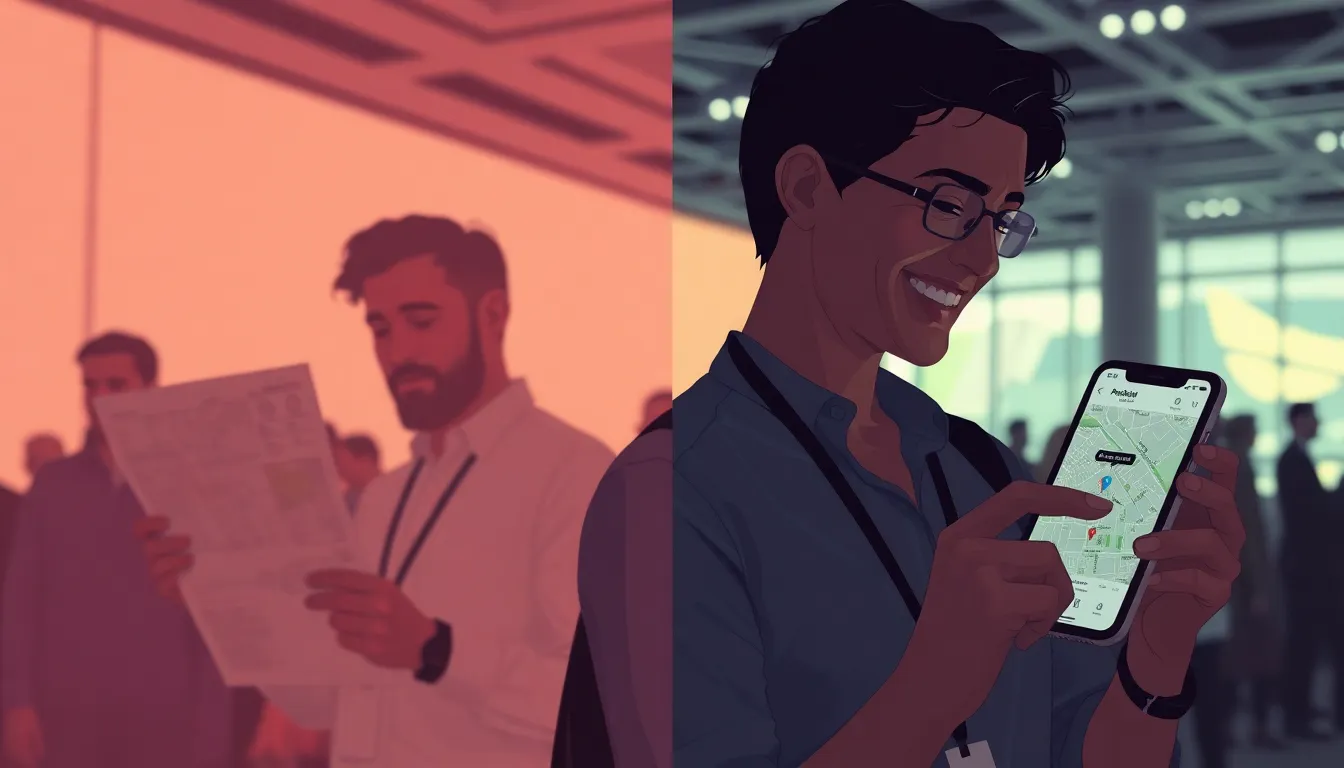
Picture this: Your attendee has just walked into your sprawling conference venue. They're excited about the keynote starting in ten minutes, but they have no idea which of the four main halls it's in. They scan the area for signage, squint at a tiny printed map, and start walking in what they hope is the right direction. Five minutes later, they're lost, frustrated, and debating whether to just skip the session altogether.
This scenario plays out thousands of times at events worldwide, and the numbers tell a sobering story. In 2026, over 53% of venue visitors report navigation problems at large events—meaning more than half your attendees are experiencing friction before they even reach your carefully planned content. But here's the encouraging news: the same research shows that 77% of venue visitors now actively use digital wayfinding tools to navigate venues, signaling both the problem and the solution.
The rise in digital wayfinding adoption isn't just about convenience—it's about meeting fundamental attendee expectations. Recent data shows that 73% of attendees expect in-person conferences to incorporate modern event technology, up from 63% in 2023. Navigation friction is no longer an acceptable part of the event experience; it's a solvable problem that directly impacts attendee satisfaction, session attendance, sponsor visibility, and overall event ROI.
The Hidden Costs of Poor Venue Navigation
When attendees can't find their way efficiently, the consequences ripple through every aspect of your event. Lost attendees mean lower session attendance numbers, which disappoints speakers and makes it harder to demonstrate value to sponsors. Confusion at the entrance creates bottlenecks that slow check-in and create negative first impressions. Attendees who spend fifteen minutes searching for the coffee station or sponsor hall are attendees who aren't networking, learning, or engaging with your carefully curated content.
The psychological impact matters too. Navigation anxiety—that nagging uncertainty about whether you're in the right place or going the right direction—drains mental energy that attendees should be investing in meaningful connections and content absorption. When someone finally finds the breakout room they were searching for, they enter flustered and distracted rather than focused and ready to engage.
The Opportunity Cost No One Calculates
Beyond frustration, poor wayfinding creates measurable opportunity costs. Consider the attendee who skips a session because they're unsure where it is, or the one who leaves your expo hall early because they can't locate the exhibitors they wanted to visit. These aren't just minor inconveniences—they're missed connections between your content and your audience, between sponsors and potential leads, between attendees who might have formed valuable professional relationships.
For multi-day events in large venues, these friction points compound. An attendee who struggles with navigation on day one is likely to adopt conservative strategies on day two: staying in familiar areas, skipping sessions in unfamiliar buildings, or leaving earlier than planned. Your venue layout shouldn't dictate your attendees' behavior—but without proper wayfinding support, it does.
The Evolution of Event Wayfinding Technology
The wayfinding tools available to event organizers have transformed dramatically in recent years. Static printed maps and directional signage—while still useful as backup—are no longer sufficient for complex, multi-space venues. Today's digital wayfinding solutions offer real-time, personalized navigation that adapts to individual attendee needs and venue conditions.
The scale at which these tools now operate is impressive. At CES 2026, the event platform logged 704,189 navigation sessions over four days, up from approximately 500,000 in 2025—a 40% year-over-year increase that demonstrates both growing adoption and growing attendee expectations. Even more telling: 91% of users provided positive feedback for the CES 2026 in-app wayfinding experience, proving that when implemented well, digital navigation genuinely enhances the attendee experience.
What Modern Wayfinding Solutions Offer
Today's digital wayfinding platforms go far beyond static venue maps. They provide turn-by-turn directions customized to an attendee's current location, highlight accessible routes for attendees with mobility considerations, and offer real-time updates when session locations change or areas become crowded. The best solutions integrate seamlessly with event apps, eliminating the need for attendees to juggle multiple tools.
Progressive event organizers are taking this further by connecting wayfinding with other engagement features. When your venue map integrates with your agenda builder, attendees can tap a session and instantly see how to get there. When it connects with gamification features, you can incentivize exploration and sponsor booth visits through location-based challenges and QR code stamp collections at various venue points.
Strategic Wayfinding: Beyond Basic Directions
The most effective event wayfinding strategies treat navigation as an engagement opportunity, not just a logistical necessity. In 2026, 71% of event planners use wayfinding apps to reduce attendee confusion, while 53% use live event maps for real-time navigation—but the real competitive advantage comes from integrating wayfinding with your broader engagement strategy.
Gamified Navigation That Drives Exploration
Consider how a digital stamp passport transforms navigation from a chore into an engaging experience. Instead of hoping attendees will explore your sponsor showcase or visit that activation space on the third floor, you can create a wayfinding-based challenge: "Collect stamps from five different venue zones to earn leaderboard points and qualify for prizes." Suddenly, navigation becomes discovery, and venue friction becomes venue adventure.
This approach works because it aligns attendee incentives with your event goals. You want attendees to discover sponsors, explore the full venue, and maximize their event experience. They want to feel like they're getting the most value from attending and perhaps win recognition or rewards along the way. QR codes positioned at strategic wayfinding points—session check-ins, sponsor booths, networking lounges—create a natural bridge between moving through space and engaging with content.
If you're curious how this looks in practice, you can see it in action through an interactive demo that shows how stamp passports, leaderboards, and venue exploration challenges work together to reduce navigation friction while increasing engagement.
Wayfinding That Facilitates Networking
Smart wayfinding also enhances attendee networking. When your venue map integrates with attendee profiles and interest-based matching, it can suggest not just where to go, but who else is heading to the same session or currently in the networking lounge. This transforms navigation from a solitary task into a social opportunity: "Three attendees with interests matching yours are in the Innovation Hall right now."
For structured networking activities, location-aware tools can prompt attendees when they're near someone they've requested to connect with, or when they're in an area designated for specific networking themes. This location-social integration helps overcome the natural hesitation many attendees feel about approaching strangers at events.
Practical Implementation: Building Better Wayfinding Experiences
Effective wayfinding requires both technology and thoughtful design. The best digital tools can't compensate for confusing venue layouts or contradictory signage, while the clearest physical wayfinding won't help attendees who need real-time updates or personalized directions.
Start with Venue Mapping and Zone Strategy
Begin by creating clear, logical venue zones with memorable names. "Building B, Third Floor, Room 347" is difficult to remember and communicate; "Innovation Lab in the Skylight Building" is both more memorable and more interesting. Work with your venue to establish a consistent naming and numbering convention, then carry that convention through all your materials—digital maps, signage, agenda listings, and announcements.
Map your attendee journey from the most common entry points. Where will people naturally enter? What's the first decision point they'll encounter? Where are the bottlenecks likely to form? Use this journey mapping to position both physical signage and digital wayfinding prompts where they'll be most helpful.
Layer Digital and Physical Wayfinding
The most robust strategy combines digital tools with strategic physical signage. Place QR codes at key decision points—venue entrances, hallway intersections, elevator banks—that attendees can scan to open an interactive map showing their current location. This hybrid approach accommodates different attendee preferences while ensuring no one gets truly lost due to a dead phone battery or connectivity issues.
Physical signage should direct attendees to major zones and key locations (registration, main stage, restrooms, food service), while your digital platform handles granular, personalized directions to specific sessions, booths, or meeting points. This division of labor plays to each medium's strengths.
Enable Real-Time Updates and Communication
One of digital wayfinding's greatest advantages is the ability to communicate changes instantly. When a session moves to a larger room due to high demand, or when an area needs to be temporarily closed, you can update the map and push notifications to affected attendees immediately. This real-time responsiveness eliminates the "I went to the listed location but the session isn't here" frustration that printed programs can't address.
Build a workflow for your event staff to submit location updates and navigation issues during the event. Empower your tech team to make real-time adjustments based on this feedback. The faster you can identify and fix wayfinding problems, the fewer attendees will be affected.
Test Your Wayfinding Before Event Day
Conduct wayfinding tests with staff or volunteers before attendees arrive. Give them realistic scenarios—"You're arriving from the north parking garage and need to get to the opening keynote in ten minutes"—and watch how they use your tools. Where do they hesitate? What questions do they ask? These tests reveal gaps in your wayfinding strategy that aren't obvious from a planning perspective.
If possible, conduct a soft launch with early arriving attendees or VIP guests, gathering feedback you can act on before the general attendance arrives. First impressions matter, and wayfinding is often the first real interaction attendees have with your event infrastructure.
Measuring Wayfinding Success
How do you know if your wayfinding strategy is working? Several metrics can provide insight into both attendee behavior and navigation effectiveness.
Quantitative Metrics
Track digital map usage: how many attendees accessed the map, how frequently, and at what times during the event. High usage suggests attendees find the tool valuable; low usage might indicate they're not aware of it or prefer other navigation methods. Monitor which areas attendees search for most frequently—this reveals which parts of your venue are hardest to find or most poorly signed.
Session attendance patterns can also indicate navigation effectiveness. If sessions in certain areas consistently show lower attendance than similar content elsewhere, navigation friction may be a contributing factor. Similarly, if late arrivals cluster in certain venue zones, that suggests attendees have trouble finding or reaching those areas on time.
Qualitative Feedback
Post-event surveys should include specific questions about navigation: "How easy was it to find your way around the venue?" and "What navigation challenges did you experience?" These open-ended questions often surface issues that metrics alone won't reveal.
Monitor social media and real-time feedback channels during the event for navigation-related comments. Complaints about getting lost or confused signage should trigger immediate investigation and, if possible, rapid response.
Staff Observations
Train your event staff to note and report wayfinding issues they observe or hear about. Staff stationed at information desks can track which questions they're asked most frequently—if "Where is Room 204?" comes up dozens of times, you have a signage or wayfinding communication problem in that area.
Integration with Comprehensive Event Engagement Platforms
While standalone wayfinding apps have their place, the most seamless attendee experience comes from platforms that integrate navigation with agenda management, networking, gamification, and sponsor visibility. When these features work together, attendees need just one tool to access everything your event offers.
Consider how integrated features enhance each other: Your agenda builder shows personalized session recommendations based on attendee interests, and when they select a session, the map shows exactly how to get there. As attendees check in to sessions via QR codes, they earn points toward your leaderboard while the system confirms they've found the right location. Sponsors appear on the map with interactive profiles, making it easy for attendees to plan booth visits and learn about exhibitors before arriving at the expo hall.
This integration eliminates the app-switching friction that undermines adoption. When attendees need to toggle between separate apps for scheduling, maps, networking, and engagement features, many will simply stop using all of them. A unified platform ensures every feature reinforces the others. You can explore all features that work together to create these cohesive attendee experiences.
Future Trends in Event Wayfinding
As we move further into 2026 and beyond, several emerging trends will shape how events approach venue navigation. Augmented reality wayfinding, where attendees hold up their phones to see directional overlays on the real world, is transitioning from novelty to practical tool for complex venues. Indoor positioning systems using Bluetooth beacons provide more accurate location tracking than GPS-based solutions, enabling turn-by-turn directions that work reliably inside large convention centers.
AI-powered navigation assistants will increasingly offer proactive suggestions: "Your next session starts in 15 minutes in the North Hall. Based on your current location, you should start heading there in about 5 minutes. Would you like directions?" This predictive approach reduces the cognitive load on attendees, letting them focus on content and connections rather than constantly checking maps and schedules.
We'll also see deeper integration between wayfinding and accessibility features. Navigation tools will offer customized routes based on mobility needs, visual impairments, or sensory considerations, ensuring that all attendees can navigate venues with confidence. Voice-guided navigation and haptic feedback will complement visual map interfaces.
Making Wayfinding a Competitive Advantage
When you solve the "where do I go next?" problem effectively, you don't just eliminate friction—you create a competitive advantage. Attendees who navigate confidently spend more time engaging with your content, sponsors, and each other. They're more likely to explore beyond the main stage, discover unexpected connections, and feel satisfied with their investment in attending.
The data from 2026 makes clear that digital wayfinding has crossed the threshold from nice-to-have to essential infrastructure for events in large or complex venues. With over three-quarters of venue visitors now actively using these tools, failing to provide effective digital navigation means disappointing the majority of your audience before they even reach your first session.
But the real opportunity lies in treating wayfinding as an integrated part of your engagement strategy. When navigation, gamification, networking, and content discovery work together seamlessly, you create the kind of attendee experience that generates enthusiastic word-of-mouth and strong return attendance. You transform the logistical challenge of moving people through space into an opportunity to guide them toward meaningful experiences.
The venues aren't getting smaller or simpler, and attendee expectations continue to rise. The question isn't whether to invest in modern wayfinding solutions—it's how quickly you can implement approaches that turn navigation from a pain point into a strength. Your attendees are ready for this shift; the technology is proven and accessible; and the positive impact on every event metric makes the case clear. It's time to eliminate "where do I go next?" friction and let your attendees focus on why they came: to learn, connect, and engage with everything your event has to offer.
Ready to create a seamless navigation experience integrated with gamification, networking, and engagement features? Event Passport PRO brings together QR code stamp passports, interactive venue wayfinding, live leaderboards, attendee networking, and sponsor showcases in one comprehensive platform. View pricing and discover how easy it is to transform your next event into an engaging, friction-free experience that attendees will remember for all the right reasons.