
In the southern sky there's a constellation called Vela. Ancient astronomers saw one enormous constellation there, Argo Navis, the ship of the Argonauts, and it was later divided into three: Carina the keel, Puppis the stern, and Vela the sails. The word is Latin for "sails," and in Portuguese and Spanish it still means sail today.
We chose that name for the biggest thing we've ever built into Event Passport PRO, and we chose it deliberately. The crew of a ship doesn't push it forward. They say where they're going, and the sails catch the wind and do the work.
That's the relationship we wanted attendees to have with event networking. Because until today, every networking tool on the market, including ours, has worked the same way: analyze attendee profiles, calculate compatibility, and show each person a ranked list of matches. Good matching matters, and ours works well. But a match list has a ceiling. It tells an attendee who they should meet, then leaves the hardest part to them: reaching out, waiting, following up, hoping. At a 1,000-person trade show, the right people are in the room. Whether you actually sit down with them mostly comes down to effort and luck.
Vela removes the effort and the luck. Attendees say where they're going. Vela does the work.
What Is Vela?
Vela is an AI concierge for events, built on something the industry hasn't seen before: a network of AI agents, one working for every attendee, negotiating with each other until the meetings are booked.
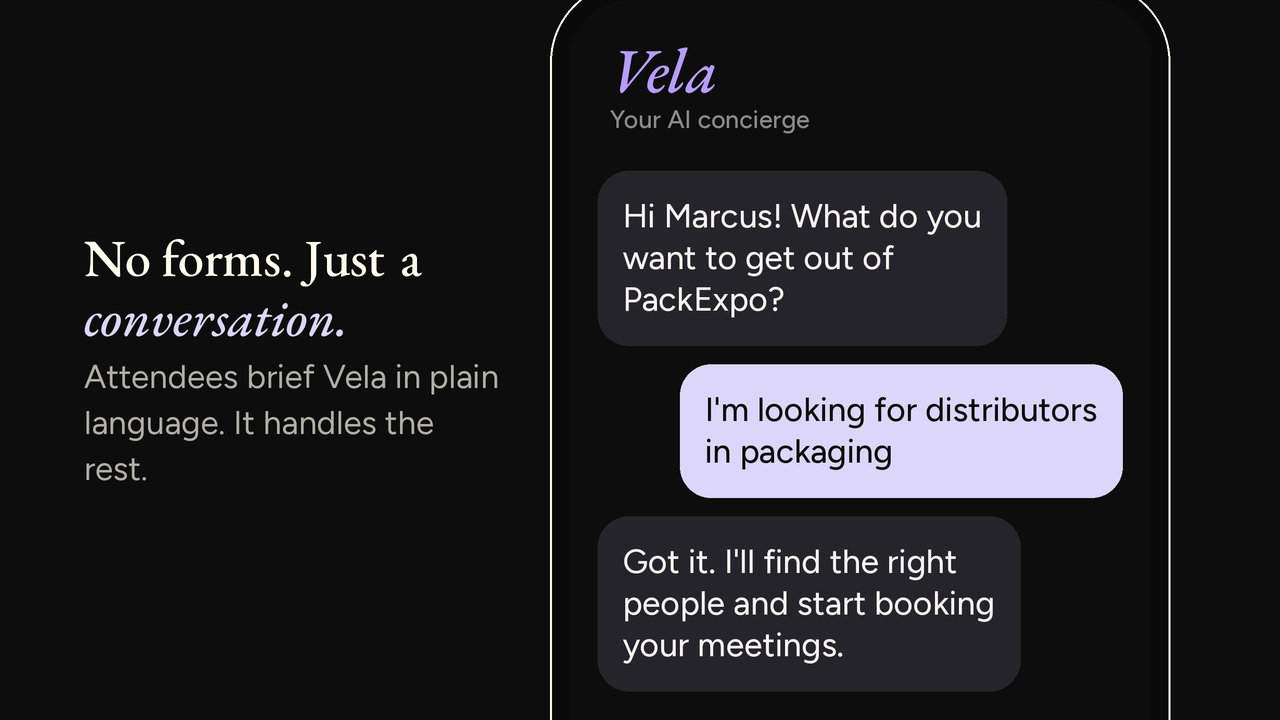
Here's what that means in practice. When attendees join your event, Vela interviews each of them in a short, plain-language conversation. No profile forms, no checkbox taxonomies. An attendee simply says what they came for: "I'm looking for distributors in packaging," or "I need to meet marketing leaders in retail."
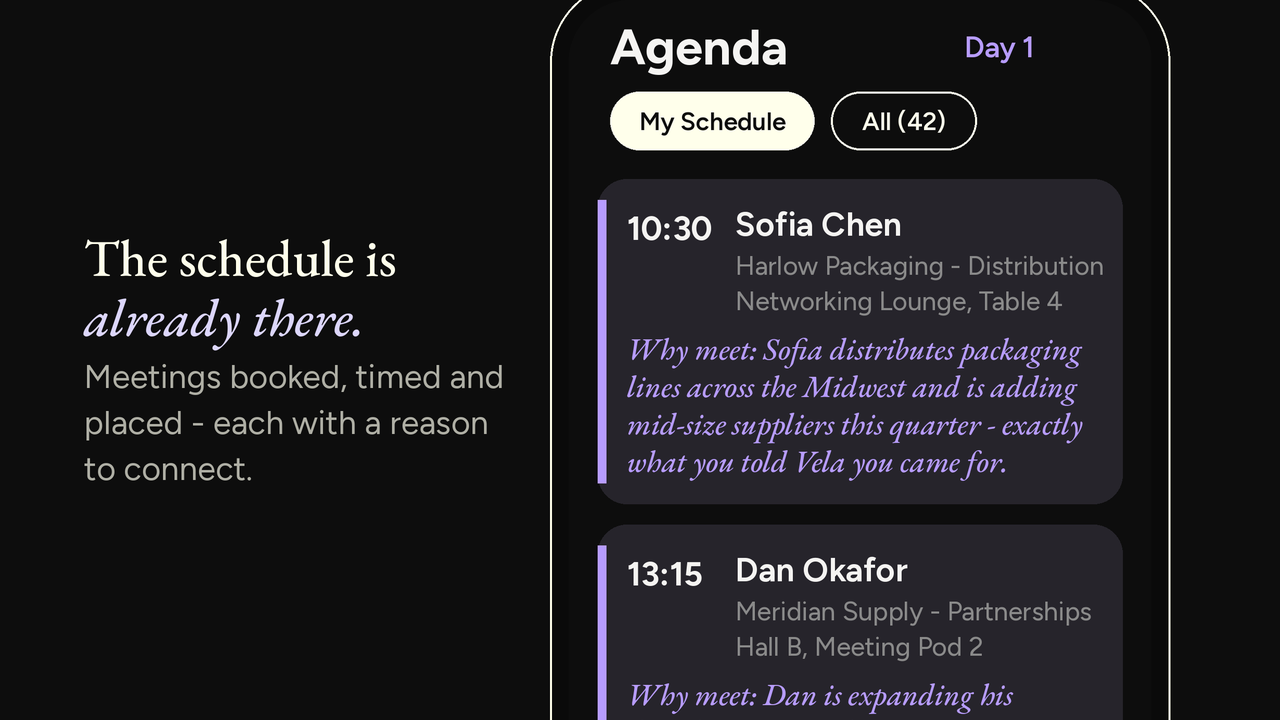
From that moment, their agent goes to work. It scans the entire room, identifies the people who fit, and negotiates directly with those attendees' agents: trading availability, weighing fit on both sides, and locking a meeting only when both agents agree it's worth their person's time. The attendee doesn't send a single request. They open the app and their schedule is already there: each meeting with a time, a place, and a written reason the two should connect.
From Matching to Booked Meetings
The difference between AI matchmaking and Vela is the difference between a recommendation and a result.
AI matchmaking, which remains part of Event Passport PRO, answers the question "who is worth my time?" Vela answers the question that actually determines whether an event pays off: "is the meeting on my calendar?" Those are different technologies. Matching is a ranking problem. Vela is a negotiation running across hundreds or thousands of agents at once, each advocating for its own person, and the system keeps working as new attendees register and plans change.
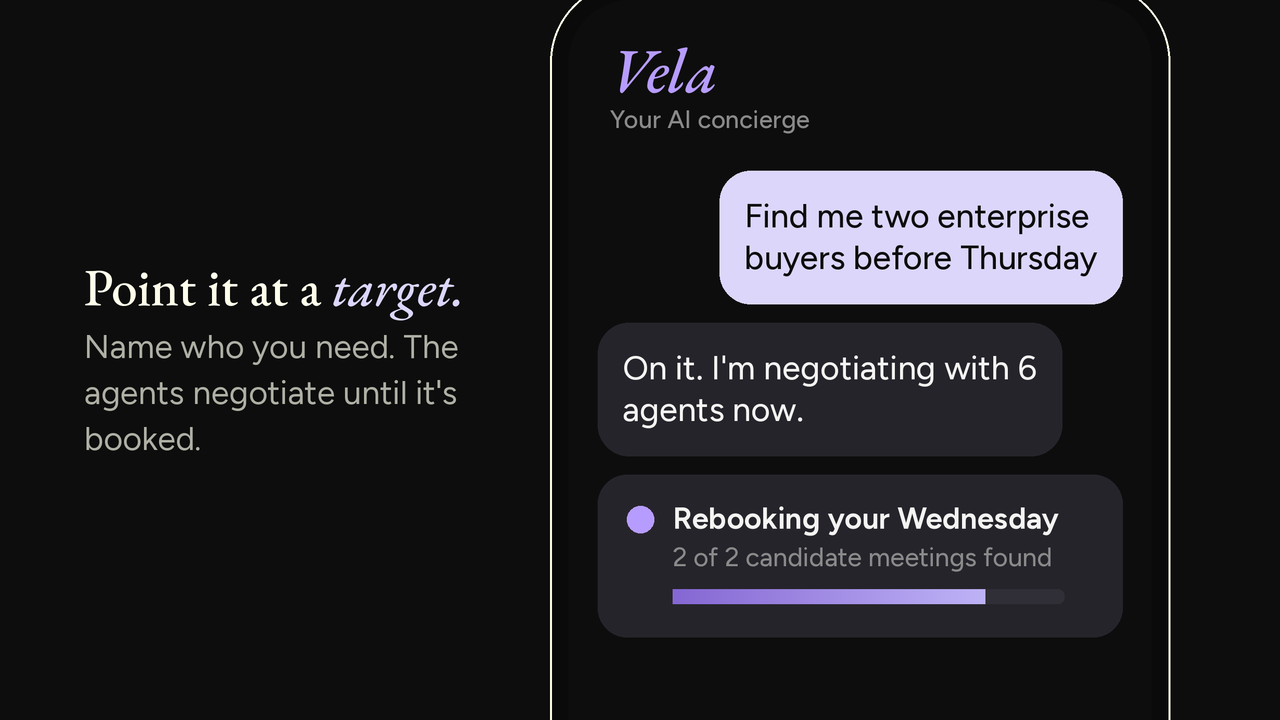
The part that changes what's possible: attendees can point their agent at a target. "Find me a Series A investor in climate." "I need two enterprise buyers before Thursday." The agent finds those people in the room and negotiates the meetings on their behalf. A ranked list can't do that. A room full of agents can.
And when a booked meeting isn't quite right, the attendee just says so: "I'm after channel partners, not vendors." Vela rebooks.
Why Organizers Should Care
Attendees don't renew because your event had good sessions. They renew because they met the right people. Post-event surveys across the industry consistently rank networking as a top reason to attend B2B events, and the most common complaint is the same every year: "I didn't meet the people I came for."
Vela attacks that complaint directly, and the effects compound for organizers:
Higher perceived event value. When attendees leave with five real conversations instead of a browsing history, your event is the one that "actually worked." That is what drives renewals, referrals, and ticket price tolerance.
Engagement without nagging. Because meetings appear in each attendee's agenda with a reason attached, attendees open your event app repeatedly and early. That lifts adoption of everything else in it: your sponsors, your sessions, your gamification challenges.
A stronger sponsor story. Guaranteed, relevance-based meetings are the format sponsors and exhibitors ask for by name. Vela gives you a credible answer without running a separate hosted-buyer program.
Zero setup burden. Vela doesn't need attendees to fill in anything before it can work. The conversation is the onboarding. That removes the profile-completion problem that quietly kills most matchmaking deployments.
What Attendees Experience
From the attendee side, Vela feels less like software and more like having someone who worked the room before they arrived:
A short conversation. Vela asks what they want to get out of the event. They answer in their own words.
A schedule that builds itself. Meetings appear in their agenda: time, location, and a plain-English reason each person is worth meeting.
Course corrections in one sentence. They can redirect their agent at any point, and it renegotiates as the event evolves.
There's no learning curve because there's nothing to learn. If an attendee can describe what they want, Vela can go get it.
Availability
Vela is live today and included in the PRO plan. No add-on fee, no separate module. If you're running an event on Event Passport PRO, you can enable Vela for your next event right now, and your attendees' agents start working the moment registration opens.
If you're not on PRO yet, book a demo and we'll show you Vela working on a live event room.
FAQ
Is Vela replacing AI matchmaking in Event Passport PRO? No. Matching remains part of the platform and feeds the agents useful signals. Vela is a different layer: it turns "you two should meet" into a meeting that's actually on both calendars.
Do attendees need to fill in a profile for Vela to work? No. Vela briefs each attendee through a short conversation. That conversation is all it needs to start finding people and booking meetings.
What happens when two attendees' goals conflict? Nothing gets booked. Each agent advocates only for its own person, and a meeting is locked only when both agents agree it serves both sides. That mutual-consent rule is what keeps schedules relevant instead of full.
Can attendees decline or change meetings Vela books? Yes, in one sentence. Attendees can tell their agent a meeting isn't right or aim it at a new target, and it rebooks as the event evolves.
Is Vela available for all event types? Vela is built for any event where attendees want to meet each other: trade shows, conferences, career fairs, association events, and multi-event programs.