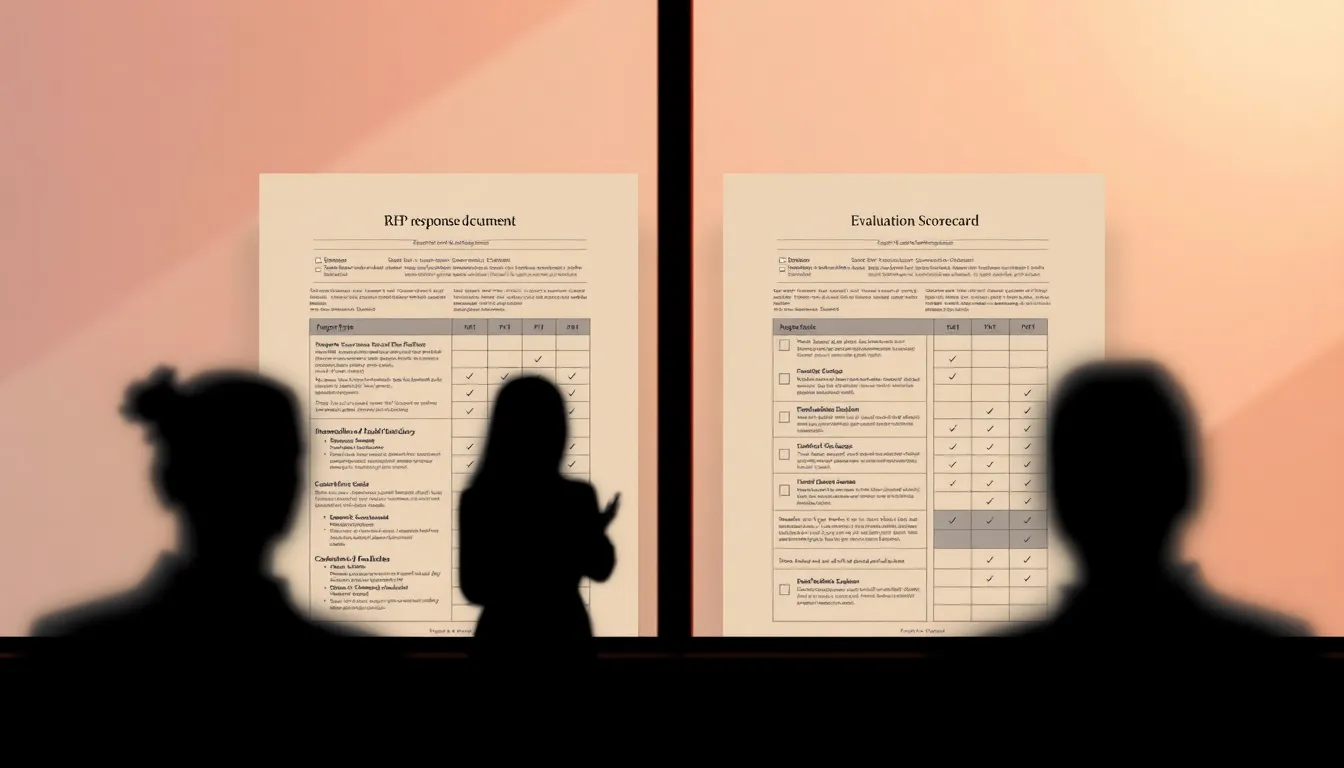
An event technology request for proposal (RFP) should produce answers you can compare side by side. Instead, most organizers receive a stack of glossy PDFs filled with custom packages, undisclosed add-ons, and pricing that requires three follow-up calls to decode. The problem is rarely the vendors. It is the RFP itself.
When your questions are vague, generic, or formatted as an open essay prompt, every vendor will shape their response to highlight strengths and bury limitations. A strong RFP removes that flexibility. It defines exactly what you need, asks for information in a structured format, and sets clear evaluation criteria before the first proposal arrives.
This guide walks you through building an event tech RFP that turns sales pitches into comparable, actionable data.
Start With Internal Alignment on Scope and Priorities
Before you write a single question for vendors, your internal team must agree on three things: which parts of your event require technology, what problems that technology must solve, and how you will measure whether it succeeded.
Begin by listing every attendee-facing and organizer-facing workflow in your event. Registration and ticketing, admission at the door, agenda publishing, sponsor visibility, attendee networking, engagement activities, post-event surveys, and analytics all represent distinct capability areas. Not every event needs all of them, and not every platform provides all of them well.
Rank your list. Identify two or three capabilities that are non-negotiable, a handful that are important but flexible, and the rest that are nice to have. This ranking becomes the backbone of your evaluation rubric and prevents vendors from winning your business by overselling features you will never use.
Finally, define success metrics for each priority capability. If engagement is a goal, decide whether success means stamp collection, session attendance, networking meetings booked, or all three. According to EventsAir, 74% of event professionals in 2026 identify engagement as a key success factor, while 39% cite engagement as one of their top challenge areas. That gap exists in part because engagement means different things to different organizers. Your RFP must make your definition explicit.
Define Technology Scope and Vendor Requirements
Broad RFPs attract responses from vendors who offer a tiny sliver of what you need and others who offer far more than you will ever deploy. Narrow your scope by naming the exact capabilities you require, the capabilities you want to evaluate as optional add-ons, and the capabilities that are out of scope for this procurement.
A 2025 report from Splash found that 78% of surveyed U.S. marketers used event technology during the prior 12 months, and 88% planned to invest in event technology in 2025. As adoption increases, so does the range of solutions in the market. Your RFP should acknowledge that range and guide vendors toward the configuration that matches your event model.
The rising investment signals that organizers expect measurable returns. If your RFP does not specify which technologies are in scope and which success measures matter, vendors will propose the tools they prefer to sell rather than the tools you actually need.
Include technical and operational requirements as well. Does the platform need to support offline access for staff working in low-connectivity venues? Must it integrate with your existing CRM, marketing automation system, or event management software? Do you require on-site support, and if so, at what service level? Will you accept a mobile-only attendee experience, or do you require a web version?
These constraints help vendors self-select out early if they cannot meet your baseline requirements, saving everyone time and ensuring that the proposals you receive are genuinely viable.
Ask for Pricing in a Structured, Comparable Format
Pricing is where RFP responses become least comparable. One vendor quotes per event, another per attendee, a third offers annual licensing, and a fourth bundles everything into a custom package that includes services you did not request. You cannot compare these models without building a spreadsheet and reverse-engineering the math.
Instead, provide a reference scenario and require every vendor to price it the same way. Specify attendee count, event duration, number of sessions, sponsor tiers, ticketing requirements, and expected engagement activity. Then ask each vendor to break down their pricing into clear line items: platform subscription or license fee, per-attendee charges, per-ticket payment processing fees, setup or onboarding fees, support fees, and any other costs.
Require vendors to state their payment processing fee structure separately from platform fees. Many platforms charge a per-ticket platform fee in addition to the credit card processor's fee. When these are bundled or described vaguely, it becomes impossible to calculate the true cost of selling tickets.
Ask vendors to provide a second pricing example at a different scale. If your reference scenario is 500 attendees, ask for pricing at 1,000 attendees and at 200 attendees. This reveals how pricing scales and whether a platform that looks affordable at small volumes becomes prohibitively expensive as your program grows.
Request contract term options. Some vendors require annual commitments, others allow month-to-month, and some offer discounts for multi-year deals. If your event program includes seasonal peaks or occasional one-time activations, monthly pricing may save money even if the per-event rate is higher.
Event Passport PRO uses a monthly subscription model based on attendee volume, with separate per-ticket fees for paid ticketing. For paid tickets, the PRO plan charges a $0.99 platform fee per ticket plus standard Stripe processing fees, while the Free plan charges a $1.99 platform fee per ticket plus Stripe processing fees. This structure separates platform access from transaction costs, making it easier to forecast expenses as attendance fluctuates across multiple events.
Define Engagement and Measurement Requirements
Engagement is one of the most overused and under-defined terms in event RFPs. Vendors interpret it in wildly different ways. Some will pitch live polling and Q&A tools. Others will emphasize gamification, networking features, or branded content hubs. If your RFP simply asks how a platform drives engagement, you will receive a stack of answers that address entirely different problems.
Be specific. If you want attendees to visit every sponsor booth, say so and ask how the platform tracks and incentivizes that behavior. If you want attendees to connect with each other, describe whether you mean browsing profiles, requesting one-on-one meetings, or joining topic-based discussion groups.
For example, some platforms offer gamification through QR code stamp collection, where attendees scan codes at booths, sessions, or activations to earn points and compete on leaderboards. Others focus on attendee networking by enabling profile browsing, interest filters, and meeting requests. These are both engagement strategies, but they serve different goals and require different vendor capabilities.
Define how you will measure engagement success. Will you track the number of stamps collected, the percentage of attendees who complete a passport, the number of networking meetings booked, the average session attendance per person, or the survey response rate? Each metric requires different data collection and reporting, so your RFP should ask vendors to explain exactly how their platform captures, stores, and exports the data you need.
Specify Reporting and Analytics
Most event platforms promise robust analytics. Few deliver reports that answer the questions your stakeholders actually ask. Your RFP should specify which reports you need, in what format, and how often.
According to EventsAir, in 2026, 83% of event professionals use attendance as a core success metric, while 82% prioritize attendee feedback as an equally critical measure. Your RFP should require vendors to demonstrate how their platform reports on both dimensions.
For attendance, ask how the platform tracks registration, admission, and session-level participation. Can you see real-time admission velocity at the door? Can you export session check-ins by time, track, or attendee segment? Can you compare planned capacity against actual attendance?
For feedback, specify whether you need in-app surveys, post-event email surveys, or both. Ask whether the platform supports multiple question types, conditional logic, and custom response scales. Request sample survey reports and ask how raw responses are exported.
Require vendors to provide sample reports or screenshots of their dashboards. Generic promises of insights and visualizations are not useful. You need to see whether their default views match your reporting needs or whether you will spend hours each week exporting CSVs and rebuilding charts in spreadsheets.
Ask about data export and ownership. Can you download registration lists, engagement activity, survey responses, and sponsor interactions as CSV or JSON files? Do you retain access to historical data after your contract ends? Can you share reports with stakeholders who do not have platform accounts?
Require Transparent Feature Availability and Limitations
Every event platform has features that sound great in a sales deck but come with significant limitations in practice. Your RFP should ask vendors to disclose those limitations up front, in writing, so you can evaluate real-world usability rather than theoretical capability.
For registration and ticketing, ask whether pricing is configured at the event level or the experience level. Some platforms let you set different ticket prices for different sessions within a multi-day conference, while others apply one pricing model to the entire experience. If you plan to offer free general admission plus paid VIP upgrades or workshop add-ons, you need to know whether the platform supports that structure.
For admission, clarify the difference between door-entry workflows and activity check-ins. Some vendors use the term check-in to describe both, which creates confusion about what data you are actually collecting. Ask how the platform handles re-entry, duplicate scans, offline mode for staff devices, and name lookup when an attendee forgets their QR code.
For sponsorship tools, ask how sponsor leads are captured. Some platforms require exhibitors to scan attendee badges with hardware that you must rent or purchase separately. Others capture leads digitally when an attendee claims an offer or requests contact in the app. These workflows produce very different exhibitor experiences and cost structures.
For integrations, ask which systems the platform connects to, whether those integrations are included or require add-on fees, and whether data flows in real time or on a scheduled batch. Request documentation or API specs so your technical team can assess feasibility before you sign a contract.
Build a Scoring Rubric Before You Receive Proposals
Evaluating RFP responses without a rubric turns into a subjective debate. One stakeholder loves a vendor's design, another prioritizes cost, a third insists on a feature that only one platform offers. You end up comparing gut feelings instead of capabilities.
Create your scoring rubric immediately after you finalize the RFP questions. Assign point values to each requirement category: functionality, pricing, reporting, integrations, support, and vendor stability. Within each category, assign weights to individual criteria based on the priority ranking you created during internal alignment.
For functionality, give the highest weight to your non-negotiable features and lower weight to nice-to-have features. For pricing, score total cost of ownership across your reference scenarios, not just the headline subscription price. For reporting, score the usability and completeness of sample dashboards and exports. For integrations, score both the number of supported systems and the quality of documentation.
Decide whether pricing will be evaluated on absolute cost or value relative to features delivered. A platform that costs twice as much but delivers three times the functionality may score higher on value, depending on your priorities.
Share the rubric with your evaluation team before responses arrive. This ensures everyone understands how decisions will be made and reduces the risk that one vocal stakeholder derails the process with last-minute objections.
Plan for the Finalist Demo and Reference Calls
RFP responses tell you what vendors claim they can do. Demos and reference calls show you what they actually deliver. Build both into your evaluation timeline and prepare structured questions for each.
For demos, provide a script or scenario that mirrors your actual event. Ask the vendor to walk through the complete attendee journey, from registration through admission, engagement, networking, and post-event survey. Ask them to show the organizer dashboard, demonstrate a live report export, and simulate a common support request like changing a session time or issuing a refund.
Do not let vendors control the demo agenda. If they skip a feature or workflow you care about, it is often because the implementation is clunky or incomplete. Require them to demonstrate every item on your priority list.
For reference calls, ask the vendor to connect you with two or three current customers whose event profile matches yours in size, format, and goals. Prepare a list of questions about onboarding time, hidden costs, support responsiveness, feature reliability, and whether they would choose the platform again.
Ask references what they wish they had known before signing. The answers often reveal gaps that no RFP response or demo will show.
A Clear RFP Protects Your Budget and Your Program
An event tech RFP is not a formality. It is the tool that determines whether you spend the next year fighting with a platform that does not fit your needs or confidently executing events that deliver measurable results. The effort you invest in defining scope, structuring questions, and building evaluation criteria pays off in every event you run on the platform you select.
A structured RFP also establishes a baseline for accountability. When a vendor commits to specific capabilities, pricing, and support terms in their response, you have a written record to reference during contract negotiations and implementation. Vague responses protect vendors. Specific, comparable responses protect you.
Start your next event technology search with a transparent pricing structure and a clear understanding of what you are buying. Compare platform pricing models to see how attendee-based subscriptions and itemized fees create predictable costs across your event program.